

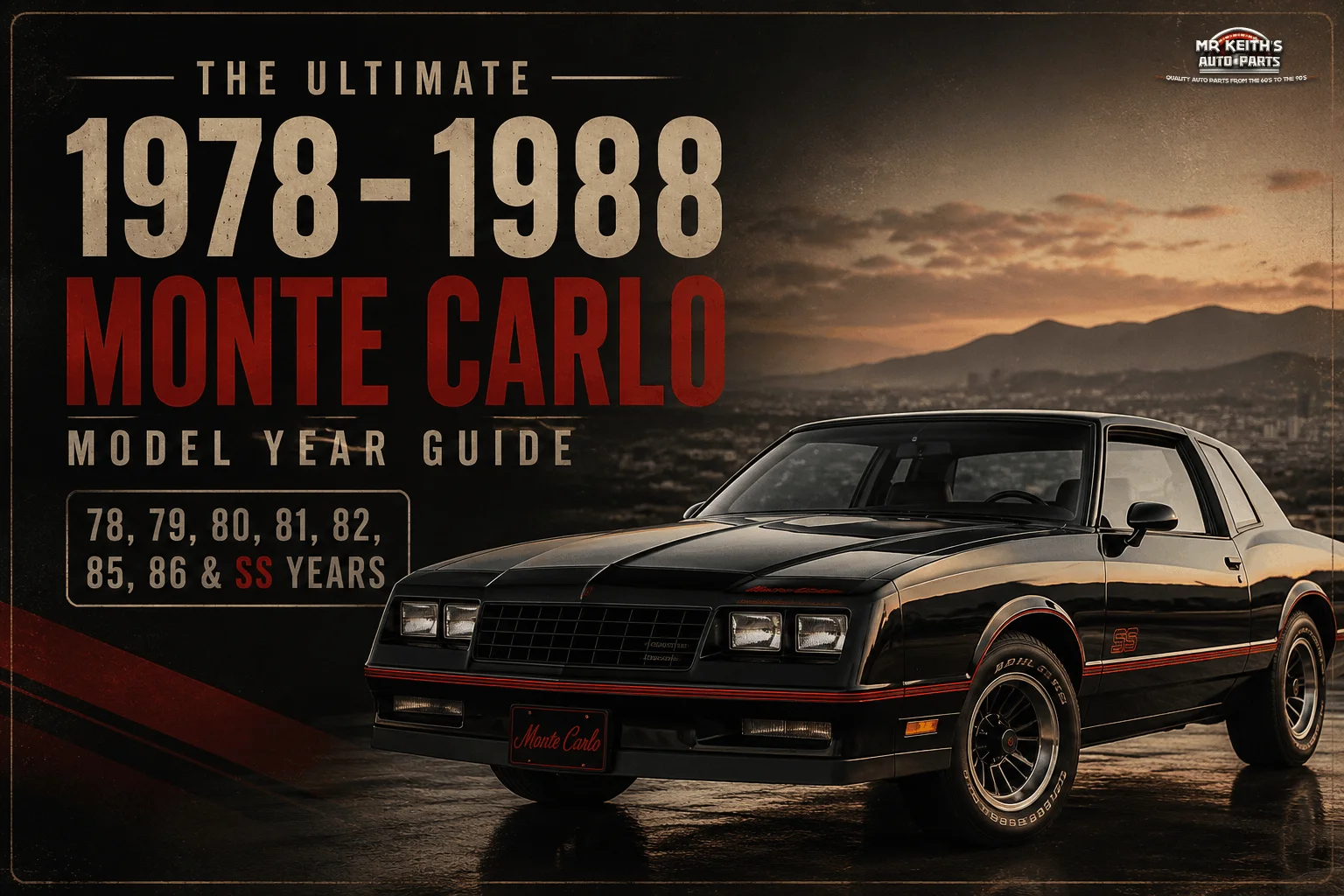
The Chevrolet Monte Carlo was built on GM’s G-Body platform from 1978 through 1988, spanning eleven model years that ranged from the plain, fuel-conscious base coupes of the late ’70s to the aggressive Monte Carlo SS of the mid-’80s. Knowing which year you have — and what changed between them — is the first step to ordering the right trim, lighting, and molding parts for a restoration.
This guide walks through every G-Body Monte Carlo model year, what changed each year, and which parts are specific to which years, so you can identify your car correctly before you order anything.
Why “G-Body” Matters More Than Just “Monte Carlo”
The Monte Carlo name has been used on three completely different GM platforms since 1970. The 1970-1977 cars were built on GM’s larger “Colonnade” mid-size platform. In 1978, GM downsized the entire Monte Carlo lineup onto the new G-Body platform — the same basic architecture shared with the Chevrolet Malibu, Oldsmobile Cutlass Supreme, Buick Regal, Pontiac Grand Prix, and Chevrolet El Camino. A fourth-generation Monte Carlo (1995-1999, front-wheel drive) came later and shares nothing mechanically or in trim with the 1978-1988 cars.
This matters directly for parts shopping: a “1976 Monte Carlo” search and a “1978 Monte Carlo” search will pull completely different body panels, trim, and lighting, even though the name is identical. Every part in this guide, and everything Mr. Keith’s stocks under Monte Carlo, is specific to the 1978-1988 G-Body generation.
Monte Carlo Model Years at a Glance
| Year | Key Changes | Notable Trim |
| 1978 | First G-Body year; new downsized body, distinct side molding clip pattern used only this year | Base, Landau (vinyl roof) |
| 1979 | Wide-bottom lower body molding replaces the 1978-only style; “European Style” and “Custom Clear” tail lens options appear | Base, Landau |
| 1980 | Continues 1979-1980 wide-bottom molding and shared tail light lens styles | Base, Landau |
| 1981 | Minor trim carryover from 1979-1980 | Base, Landau |
| 1982 | Minor trim carryover | Base, Landau |
| 1983 | Monte Carlo SS introduced — factory performance package returns | Base, Landau, SS |
| 1984 | SS continues, strong early SS production year | Base, Landau, SS |
| 1985 | SS continues; SS-specific molding clip sets used | Base, Landau, SS |
| 1986 | SS continues; late-1986 production switches to updated tail lamp housing shared with 1987-1988 | Base, LS, SS |
| 1987 | LS and SS both in lineup; late-model tail lamp housing and door molding clips | LS, SS |
| 1988 | Final G-Body Monte Carlo year; LS and SS continue | LS, SS |
1978: The First G-Body Monte Carlo
The 1978 Monte Carlo was the first year of the smaller G-Body design, trading the boxy Colonnade-era styling for a more aerodynamic, formal roofline. This is also the year with the most restoration pitfalls for parts shoppers, because several trim pieces are unique to 1978 only and were changed the very next year. The side body molding clip pattern, for instance, used a distinct configuration for 1978 “Deluxe” trim that does not carry over to 1979-1980 cars — a common mistake is ordering a 1979-1980 clip set for a 1978 car and finding it doesn’t seat correctly.
If your Monte Carlo is a 1978, always specify the year when ordering side moldings, molding clips, and vinyl top trim, since this is the single most common year-specific mismatch in the G-Body Monte Carlo parts world.
1979-1980: The Wide-Bottom Molding Years
Starting in 1979, GM switched to a “wide-bottom” style lower body side molding, replacing the narrower 1978 design. This 1979-1980 molding style also introduced two distinct tail light lens options that Monte Carlo owners still choose between today: the “European Style” lens, with a distinctive amber corner accent, and the “Custom Clear Style” lens, which is fully clear for a modern, brighter look. Both were aftermarket-style upgrades over the standard OEM lens and remain popular for owners customizing their car’s rear-end appearance.
1979 and 1980 also share side molding clip sets, which is a genuine point of interchangeability — if you’re sourcing trim hardware for either year, the same narrow-bottom-versus-wide-bottom distinction (not a 1979-versus-1980 distinction) is what determines fitment.
1981-1982: Trim Carryover Years
The 1981 and 1982 model years continued largely unchanged from the 1979-1980 trim and molding architecture, with no major styling departures. If you’re restoring a 1981 or 1982 Monte Carlo, most of the wide-bottom molding, clip, and lens information from the 1979-1980 section above applies directly — always confirm the exact molding style visible on your car against reference photos, since running production changes weren’t always announced model-year by model-year.
1983: The Monte Carlo SS Returns
1983 is the single most important year in the G-Body Monte Carlo’s run for enthusiasts: this is when Chevrolet brought back the SS package after a long absence, aimed squarely at NASCAR homologation and a return to factory performance image. The SS added a distinct front air dam, blacked-out trim, a rear spoiler, and SS-specific badging on top of the existing Monte Carlo body. Because 1983 was the first year back, original production numbers were comparatively low, which is part of why early SS cars are prized by collectors today.
1984-1985: Monte Carlo SS Comes Into Its Own
By 1984 and 1985, the Monte Carlo SS was firmly established in the lineup and production volume increased. These years share much of the same SS-specific trim and molding hardware, though — as with the base cars — it’s worth confirming exact clip and molding sets against your specific year rather than assuming full interchangeability, since GM made incremental running changes across the SS’s production run.
Explore our collection of 1978–1988 Chevrolet Monte Carlo parts
1986: The Transition Year
1986 is a genuine split year for parts fitment. Early 1986 production Monte Carlos (LS and SS) share tail lamp housing and some molding hardware with 1985 and earlier cars, while late 1986 production switched to the updated tail lamp housing and side molding clip pattern that would carry through 1987 and 1988. If you own a 1986 Monte Carlo, the single most useful thing you can do before ordering tail light or side molding parts is confirm your car’s exact production timing — early or late 1986 — since ordering the wrong version is one of the most common mistakes owners make with this specific model year.
1987-1988: The Final Model Years
The last two years of the G-Body Monte Carlo, 1987 and 1988, carried the LS and SS trim levels forward with the updated late-1986-style tail lamp housing and door/side molding clip hardware. Both OEM-style and custom clear tail lamp lens options with integrated emblems were available for these years, giving late-model Monte Carlo owners options for either a factory-correct restoration or a customized rear-end look. 1988 was the final year for the G-Body Monte Carlo before GM moved to the front-wheel-drive Lumina for 1990 (with no direct 1989 Monte Carlo).
Shopping for Monte Carlo Parts by Year
The single biggest mistake we see in Monte Carlo parts orders is treating “Monte Carlo parts” as one interchangeable category across all eleven years. In reality, several of the most commonly replaced trim components — side molding clips, tail light lenses, and vinyl top hardware — have genuine, documented year-specific differences:
- 1978 uses a distinct “Deluxe” side molding clip pattern not shared with any later year.
- 1979-1980 share a wide-bottom molding style and offer both European Style and Custom Clear tail lens options.
- 1983-1988 SS years add SS-specific trim on top of the standard body hardware.
- Late 1986 through 1988 share an updated tail lamp housing and door molding clip pattern distinct from earlier years.
Before ordering side moldings, molding clips, tail light lenses, or vinyl top trim, confirm your exact model year and, for 1986 specifically, whether your car is early or late production. When in doubt, our team can help you confirm fitment against your specific VIN and trim level.
Find the Monte Carlo parts you need for your restoration with our full category-organized inventory.