

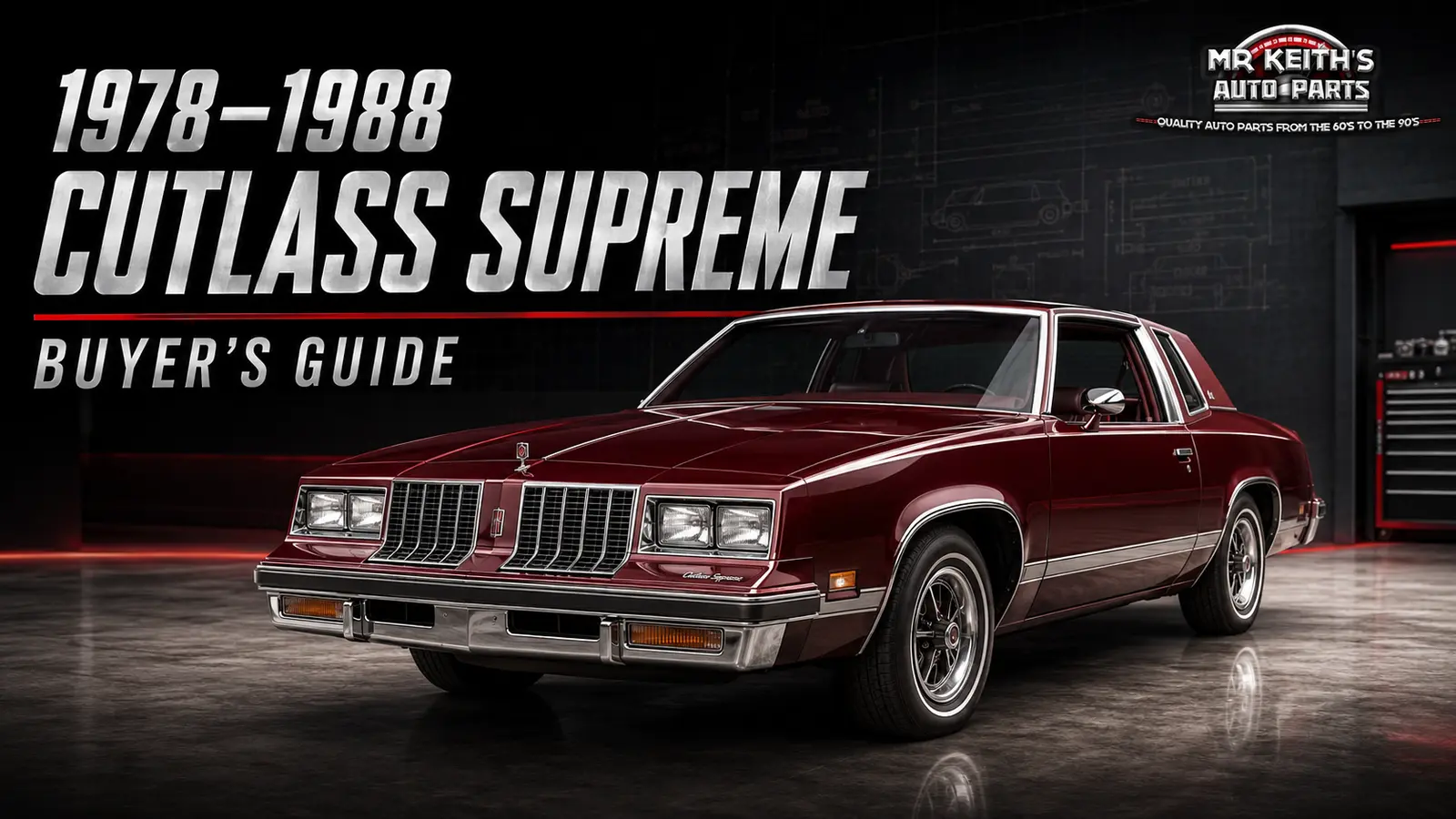
The Oldsmobile Cutlass Supreme was one of the best-selling G-Body coupes of the late 1970s and 1980s, and it’s still one of the most popular G-Body restoration platforms today — which also means there’s more misinformation floating around about which trim parts fit which years. This guide covers what to look for when buying one, the single most important fitment distinction on the front end, and which parts you should expect to replace first.
G-Body Platform, Same Rules as Monte Carlo and Malibu
Like the Monte Carlo, Malibu, Regal, El Camino, and Grand Prix, the Cutlass Supreme rode on GM’s G-Body platform from 1978 through 1988. That shared architecture is why parts shoppers sometimes assume Cutlass trim is interchangeable with other G-Body models — it generally isn’t, since each brand had its own distinct sheet metal, trim, and lighting even when the underlying chassis was shared.
The Most Important Fitment Distinction: Standard vs. “Euro” Front End
If you only remember one thing before ordering Cutlass Supreme front-end trim, make it this: the Cutlass Supreme was built with two genuinely different front-end designs, and they use entirely different parts.
- Standard four-headlamp front end — four separate round or rectangular headlamps, with a matching header panel, headlamp bezels, and grille.
- “Euro” composite two-headlamp front end — two larger composite headlamps integrated into a single grille assembly, with its own distinct header panel, bezels, grille, and hood ornament.
These two front-end styles are not interchangeable at the parts level. A header panel, bezel set, or grille built for the standard four-headlamp car will not fit a Euro-style front end, and vice versa. Before ordering any front-end trim — header panel, headlamp bezels, grille, or hood ornament — confirm which style your car has by looking directly at the headlamp configuration.
What to Inspect Before Buying a Cutlass Supreme
- Front-end style and completeness. Confirm standard vs. Euro configuration and check that header panel, bezels, and grille are present, correctly matched, and undamaged.
- Rust in typical G-Body trouble spots. Rear wheel wells, trunk floor, and rear window channel are common rust points across the G-Body lineup, Cutlass included.
- Side body molding and clips. Missing or broken clips are extremely common on project cars and are one of the most frequent “small part, big headache” issues in a Cutlass restoration.
- Vinyl top condition and corner connector hardware, if equipped, since these become brittle and crack with age.
- Tail light lens condition, since UV exposure clouds and cracks original lenses over the course of decades.
What Parts Wear Out First on a Cutlass Supreme
Based on what we see move through our own inventory year after year, the parts that fail or go missing most often on a Cutlass Supreme are:
- Tail light lenses — sun exposure clouds and cracks the original plastic over time; clear and OEM-style replacement options exist depending on whether you’re restoring to original or customizing.
- Side body molding clips — small, plastic, and easily lost or broken during any prior bodywork, these are one of the most frequently reordered parts in this category.
- Emblems and ornaments — chrome plating deteriorates and adhesive-mounted pieces fall off or go missing entirely over decades of use.
- Header panel trim and bezels — especially on Euro-style cars, where the composite headlamp bezels are more exposed to impact damage than the standard car’s individual headlamp buckets.
- Vinyl top corner connectors, on cars so equipped — these plastic pieces become brittle from UV exposure and commonly crack or break during vinyl top removal or replacement.
Sourcing the Right Cutlass Supreme Parts
Because of the standard-versus-Euro front-end split, and because trim and molding hardware changed at points across an eleven-year production run, the single best thing you can do before ordering Cutlass Supreme trim, molding, or lighting parts is confirm your exact model year and front-end configuration first
— a quick visual check against reference photos is usually enough, and our team can help you confirm fitment if you’re not sure.